
Neurogebra
A reflective exploration of intelligence, learning, and the elegance of mathematical thought.
In the modern artificial intelligence landscape, deep learning frameworks like PyTorch and TensorFlow dominate research and industry. They excel at processing massive datasets across GPUs and TPUs. However, they share a fundamental flaw: the “Black Box” problem.
When you train a neural network today, operations are executed as opaque tensor math in C++ or CUDA backends. If a model fails to converge, suffers from vanishing/exploding gradients, or experiences “dying ReLU” neurons, standard logging frameworks only show scalar loss curves, concealing why the mathematical mechanics failed inside the network.
Neurogebra is created to solve this exact problem.
What is Neurogebra?
Neurogebra is an open-source, unified Python library that bridges symbolic mathematics, numerical computation, and machine learning into a single, transparent toolkit.
Rather than viewing neural network operations as black-box numerical tensors, Neurogebra treats every activation function, loss function, optimizer, metric, and layer transform as a first-class symbolic expression powered by SymPy and NumPy.
pip install neurogebraThe Three-in-One Mathematical Expression
In Neurogebra, every mathematical expression is simultaneously three things:
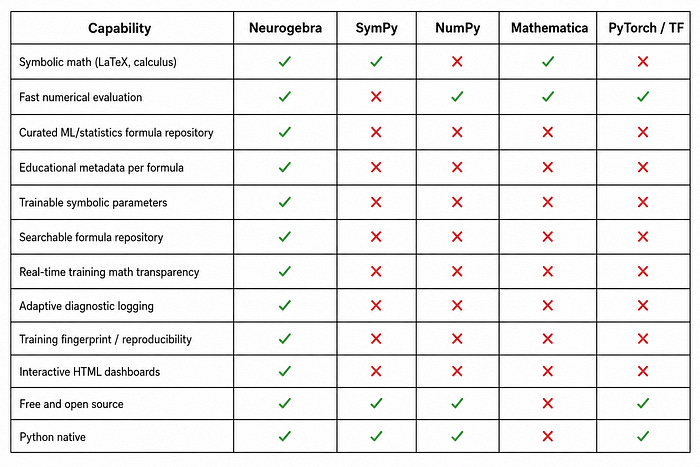
Symbolic: Full SymPy integration with LaTeX rendering and exact analytical gradients.
Numerical: NumPy-backed vectorized evaluation for execution speed.
Trainable: Attach learnable parameters and optimize them directly using built-in algorithms (Adam, SGD, etc.).
What Problems Does Neurogebra Solve?
1. The Deep Learning Diagnostic Dilemma
The Problem: Traditional training tools log macroscopic metrics (Epoch 10: Loss = 0.42). If the loss stalls, developers are left guessing whether the culprit is bad weight initialization, vanishing gradients, or activation saturation.
The Neurogebra Solution: The Training Observatory renders exact symbolic equations and live math metrics layer-by-layer directly in your terminal during training.
2. Silent Failures (Dying ReLU)
The Problem: Neurons in standard networks can quietly “die” (permanently outputting zero due to negative inputs), degrading capacity without throwing runtime errors.
The Neurogebra Solution: In controlled experimental benchmarks, Observatory Pro detected a 58.3% dying ReLU condition that seven epochs of standard aggregate logging completely concealed.
3. Log Overload
The Problem: Logging detailed internal states at every step generates gigabytes of text files, making manual inspection impossible.
The Neurogebra Solution: Adaptive Logging keeps the terminal clean during healthy training epochs (reducing log volume by 80–90%), automatically escalating verbosity and raising targeted diagnostic warnings only when mathematical anomalies occur.
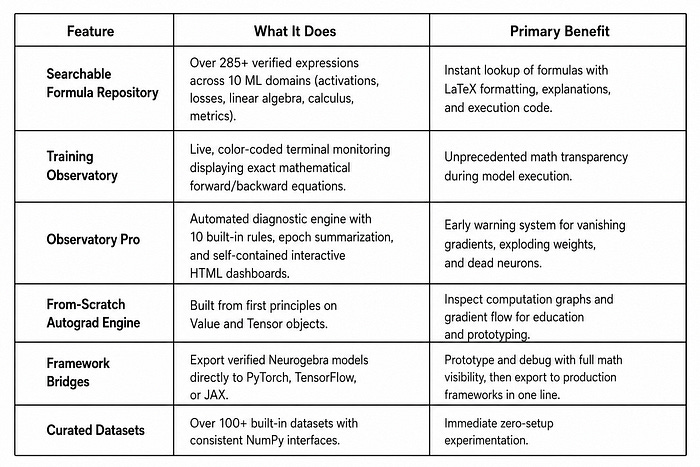
Core Features at a Glance
Why Should Students, Researchers, and Engineers Use NeuroGebra?
Unmatched Educational Insight: For students and educators, NeuroGebra removes the guesswork from learning AI math. You can inspect exact gradients, LaTeX formulas, and step-by-step computational graphs.
Rapid Prototyping & Debugging: For researchers and engineers, building novel loss functions or hybrid activations is as simple as symbolic arithmetic (custom_loss = 0.7 * mse + 0.3 * mae).
Seamless Production Workflow: Verify theoretical mechanics in Neurogebra, debug training dynamics using Observatory Pro, and then export the finalized model directly to PyTorch or TensorFlow for scale.
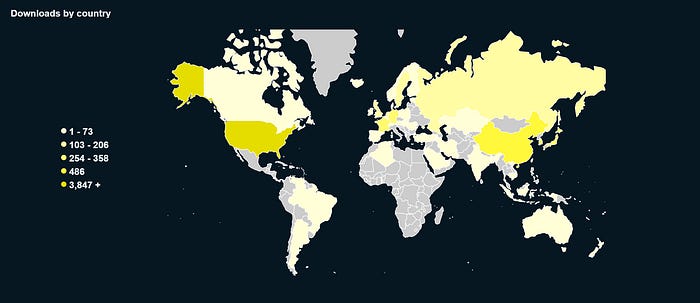
Community & Impact: Over 7,600+ downloads on PyPI, MIT open-source licensing, and comprehensive documentation make it ready for university research and open-source contributions.
Get Involved & Explore
PyPI Package: pypi.org/project/neurogebra
pip install neurogebraGitHub Repository: github.com/fahiiim/NeuroGebra
Official Documentation: neurogebra.readthedocs.io
1 reaction
Written by
Md. Fahim Sarker Mridul
Member of the Green University Computer Club